Governance
The Capital Deployment Wave Is Real. The Capability to Govern It Isn't.
Record capital is flowing into EMR projects, but the capability to govern it has not kept pace. Why capability, not capital, is now the constraint.
Read More

Project Delivery Assurance Services (PDAS) is the recognised governance engine for the Energy, Minerals, and Resource (EMR) sectors. We deliver the specialist assurance, independent verification, and technical oversight required to strengthen governance, protect capital, and provide executives with absolute confidence in delivery performance.
Book A ConsultationThe high-stakes Energy Minerals and Resources (EMR) environment demands more than generic oversight. Where failure is costly and stakeholder scrutiny is high, you need the assurance that comes with deep domain knowledge supported by precise technical controls and complemented by effective operational governance.
At the core of PDAS stands its founder, Graham Sutherland, an expert in governance, assurance, business operations, and driving operational excellence in portfolios and project delivery.
PDAS is a focused team of seasoned professionals who've managed some of the world's most complex EMR projects, bringing over 150 years' worth of collective worksite-to-boardroom experience.
At the heart of PDAS is its founder, Graham Sutherland, a recognised authority in governance and technical assurance. Holding certifications from global institutions including PMI®, AXELOS, CQI, IIBA, and NEBOSH, Graham and his expert team deliver the operational confidence that EMR organisations demand.
This capability defines the standard of governance PDAS brings to every engagement. Clients benefit from a partner whose technical depth, disciplined methodology, and independence underpin confident decision-making at every stage of the business/project lifecycle.

PDAS provides five core services that form a cohesive governance framework designed to strengthen confidence, reduce risk, and maximise long-term value.
Driving sustained performance across assets and enterprise operations. We integrate people, processes, and technology into a unified structure, enabling COOs and business leaders to achieve higher safety, reliability, efficiency, and predictable outcomes.

From concept to commissioning, we embed rigorous Front-End Planning (FEP) and data-driven governance to turn complexity into certainty. Our approach helps Project Directors & VPs mitigate volatility, control risk, and deliver assets efficiently and predictably - while providing rapid intervention and recovery strategies for projects at risk.

We drive strategic capital allocation and value creation. Through robust value frameworks and Enterprise PMOs, we optimise resources with strategy, reduce decarbonisation risk, and secure energy resilience for the future.

Governance is more than compliance, it's the backbone of strategic decision making and enterprise resilience. We integrate ESG frameworks, risk systems, and performance oversight to equip Boards with clarity and control to protect assets, accelerate growth, and sustain stakeholder trust.
That backbone now also has to carry AI. As AI enters operational decision making, the Board's questions do not change: who decides, who signs, who stops. Our AI Readiness Diagnostic is an independent, fixed-scope assessment of whether your operating model and management system are ready to answer them.

Objective verification and executive intelligence for critical decisions. From distressed project recovery and data-driven health checks, we provide CEOs and Boards with the independent scrutiny that ensures capital investments deliver their intended value.


Before committing to a transformation programme or procuring another tool, it is worth knowing whether the way you are wired can actually carry AI into operational decisions. Our free AI Readiness Snapshot asks fifteen questions and gives you an honest read on screen in about five minutes. Where it shows more than a self-assessment can settle, the full diagnostic is independent and fixed-scope.
The PDAS AI Readiness Assessment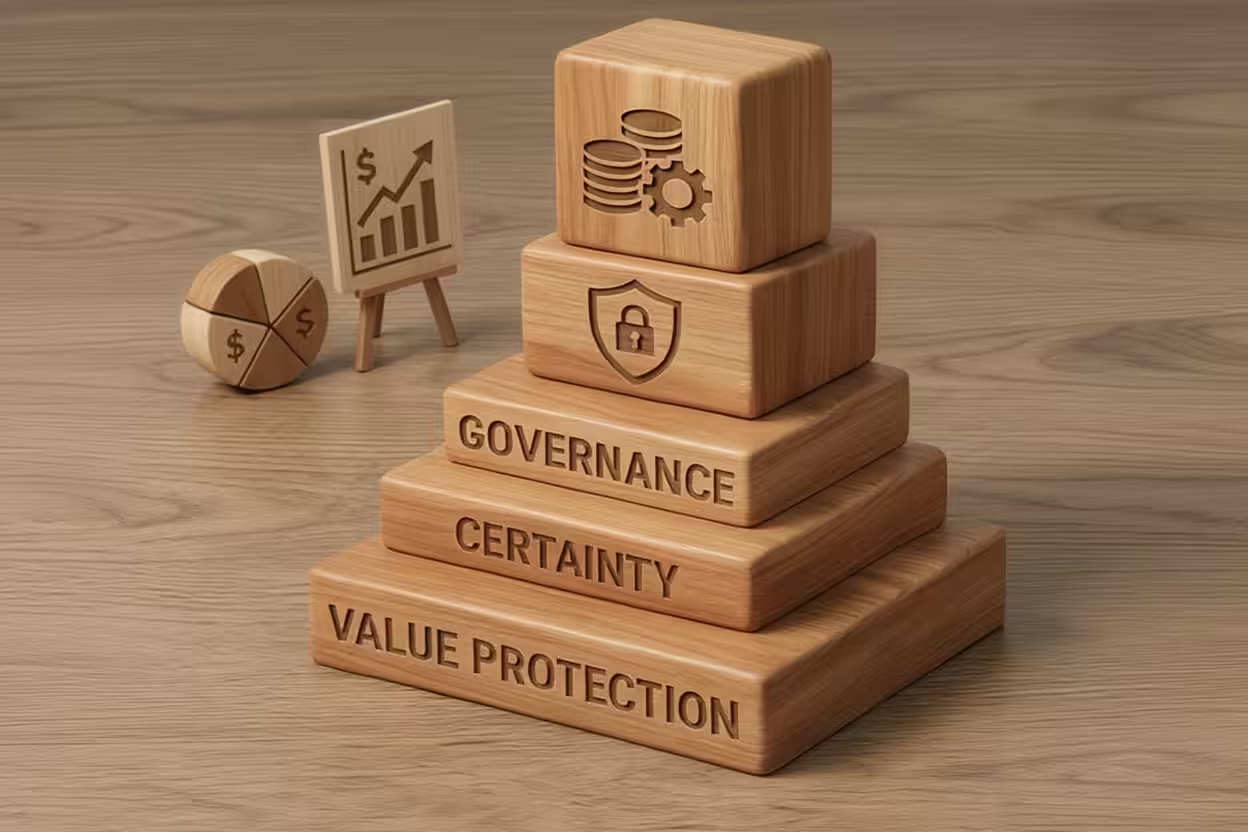
We go beyond standard reporting to prevent value leakage. By applying rigorous commercial governance and forensic business analysis, we ensure capital expenditures are strictly aligned with strategic intent - maximising ROI and protecting stakeholder value. When projects deviate from plan, we provide rapid recovery strategies to restore control, safeguard remaining investment, and secure delivery outcomes.

Generic oversight leaves gaps. Our proprietary PDAC© verification system digitises and structures the governance process, enabling us to identify, quantify and neutralise operational and execution risks before they escalate into financial or schedule impacts.

While others focus on spreadsheets, we assure the Operating model itself. Our specialists deliver robust process evaluation and integration, governance alignment, and supply chain assurance - removing gaps to guarantee that your organisation performs as designed and delivers intended outcomes.
The decisions that protect capital and govern complex projects start with the right questions. Here is what experienced executives and Boards typically want to understand before engaging an independent assurance partner.
Project delivery assurance is an independent, objective assessment of whether a capital project will actually deliver what it has promised - on time, on budget, and to the required scope and quality. Unlike the project team, whose role is to execute, an assurance function sits outside the delivery structure and reports directly to the Board or senior sponsoring body. Its core purpose is to close the gap between reported project status and observed reality - giving decision-makers an accurate, unfiltered picture of project health at every stage of the lifecycle. In high-capital industries such as energy, minerals and resources, where a 1% variance can translate into hundreds of millions of dollars of exposure, independent assurance is a critical governance control.
Project management is responsible for delivering a project - planning, resourcing, executing and controlling the work. Project assurance is responsible for independently verifying that the project management function is performing correctly and that the data it produces is reliable. The project manager asks: "Are we on track?" The assurance function asks: "Is that assessment accurate, and is the process that produced it sound?" The two roles are deliberately kept separate to avoid conflicts of interest. A project manager cannot objectively assure their own work, in the same way an auditor cannot audit the accounts they prepared. Together, they form a governance model that gives Boards and executive teams the confidence to make high-stakes capital decisions based on evidence rather than optimism.
Research consistently points to a cluster of systemic causes rather than isolated events. Poor front-end definition - where scope, cost and schedule are approved before they are sufficiently developed - is the most common root cause, compounding every subsequent decision with unreliable baselines. Optimism bias in early-stage estimates, inadequate risk identification, and governance structures that allow projects to proceed through stage gates without rigorous independent scrutiny all contribute. Critically, project teams operating under delivery pressure tend to report progress in the most favourable light available to them - not necessarily through dishonesty, but because internal reporting structures rarely incentivise bad news. By the time problems surface visibly, the cost of correction is exponentially higher than it would have been at earlier stages. Independent assurance exists precisely to surface these issues before they become irreversible.
At minimum, before any major capital sanction decision - particularly at stage-gate transitions where go/no-go calls commit significant expenditure. However, the most effective use of independent review is continuous rather than episodic: embedding assurance oversight from concept through commissioning means problems are identified and corrected in real time rather than discovered at post-implementation review. A Board should also consider commissioning an independent review whenever reported project metrics appear inconsistent with observable site or schedule progress, when a project has materially changed in scope or cost since original sanction, or when external stakeholders - including financiers, joint venture partners or regulators - require verified performance data. The question is not whether a project needs independent oversight, but how early it is introduced.

Operating from our hub in Singapore, PDAS supports clients worldwide with a boutique, high-touch approach defined by ethics, professionalism, and technical precision. Whether guiding billion-dollar portfolios or troubleshooting project-critical crises, we deliver the confidence leaders need to make high-stakes decisions.










Book a consultation and discover how PDAS can safeguard your investments, strengthen governance, and realise the full potential of your projects.